A business idea can sound like a full software platform when the immediate problem is much smaller. Someone needs to submit information, somebody else needs to review it, and both need to see the next step. That is a useful place to start an MVP.
What counts as an MVP?
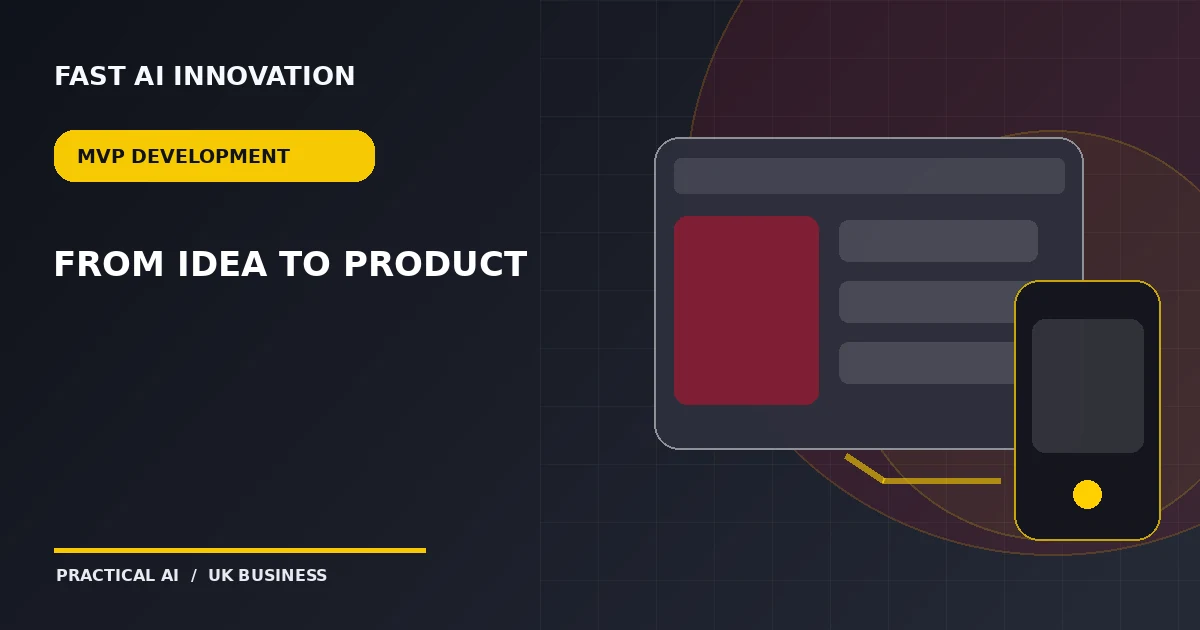
A minimum viable product is the smallest version that lets real users complete a meaningful task and gives the team evidence about what to build next. It is not a promise to launch unfinished or insecure software. The minimum is about scope, not standards.
For a service business, a useful first release might include an enquiry form, user sign-in, a secure dashboard and a simple admin queue. A later version could add automated document creation, CRM integration, reporting or AI-supported triage.
Choose the product shape
- App prototype: test navigation, user flows and assumptions before committing to a back end.
- Client portal: let clients securely upload files, check progress and communicate with your team.
- Intranet: give staff controlled access to policies, knowledge, forms and internal services.
- Operational dashboard: surface reliable data from existing systems so managers can act.
- SaaS MVP: test a repeatable software service with account boundaries, subscriptions or usage controls where required.
These are different products. The data model, security and integration needs should dictate the architecture—not the name of the technology stack.
A sensible five-stage build
- Discover: identify one user, one problem and one action that solves it.
- Prototype: create screens or a clickable flow. Challenge labels, edge cases and mobile behaviour early.
- Build: implement the smallest complete journey, including sign-in, permissions and persistence where needed.
- Test: use normal, incorrect and hostile inputs; verify that each role can see only the right information.
- Learn: monitor usage and feedback before committing to the next feature.
Where AI helps—and where it does not
AI can accelerate drafting interfaces, generating test data, structuring documentation and building tightly scoped integrations. It can also introduce errors, insecure assumptions and unnecessary dependencies. A production-ready portal still needs deliberate access control, backups, logging, accessible UX and a plan for support.
For example, an AI-assisted document summary may belong in a client portal, but that does not mean the model should automatically share the document with everyone who can sign in. Treat permissions and approval as product features.
Questions that prevent scope creep
Who owns the data? What happens when a user forgets a password? Can an administrator recover a mistaken submission? Which records need retention rules? Does the product need to work well on a phone? What is the one task a pilot user must complete without help?
These questions are less glamorous than an animated prototype, but they are the ones that separate a promising demo from a product people can rely on.
How Fast AI Innovation approaches it
We work from business need to working system: prototype, validate, build and improve. Projects can involve custom WordPress functionality, bespoke web applications, secure portals, internal tools and integrations. We do not treat a one-hour session as a universal promise of a full application; delivery depends on scope, data and acceptance criteria.
If you have a rough brief or even a sketch, a discovery call can establish what a first useful release would include, what can wait and what needs deeper engineering.
References and further reading
Want help making this work in your business?
Our AI Growth Managers do the hands-on work with you, in hours and days, not months.
- Free 20-minute call Talk through your idea or challenge with a real person.
- One-to-one session · £300 One hour to learn, build or automate something useful.
- AI sprints from £1,000 Four hours, a full day, or a zero-to-one launch.