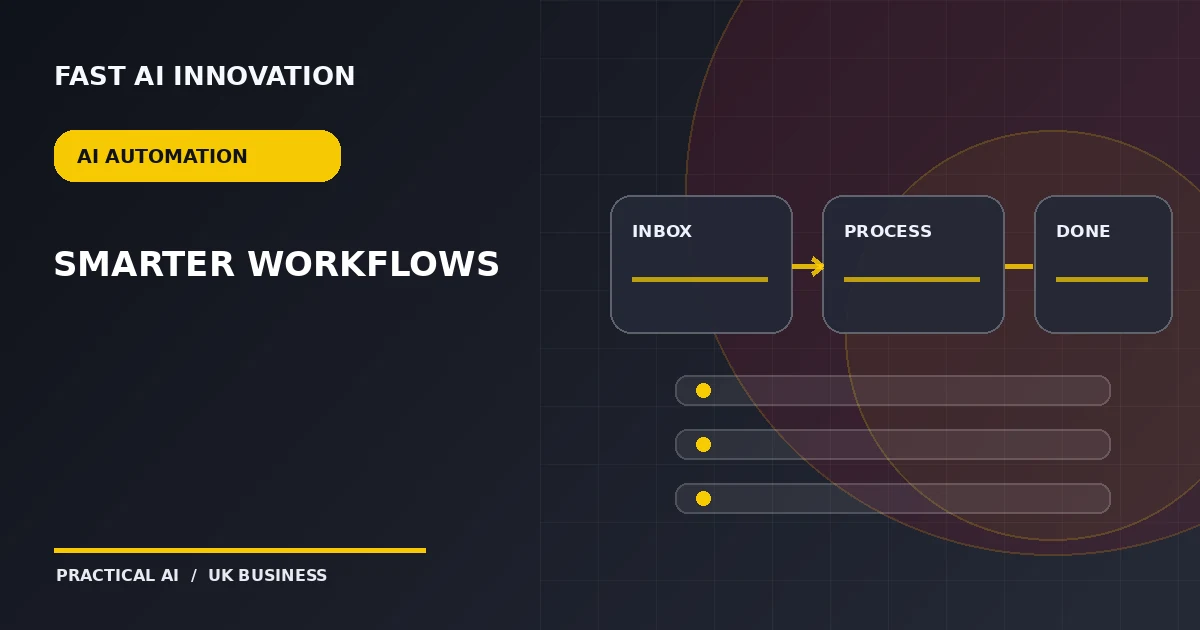
Most small businesses do not need a grand AI transformation programme. They need to stop losing time to work that repeats itself: chasing missing documents, copying details between systems, answering the same question and remembering to follow up.
AI adoption is no longer hypothetical. The Office for National Statistics reported that around 30% of UK businesses used at least one AI technology in September 2026. But using an AI tool and having an effective business process are two different things. The second is what creates value.
Choose the first workflow by measuring friction
Ask a simple question: What task happens often, follows a recognisable pattern and still needs somebody to check it? For a professional-services company, that could be turning an incoming enquiry into a CRM record and a draft response. For a clinic, it might be appointment enquiries and reminders. For a trades business, it could be collecting job details before preparing a quote.
Map the current process before automating anything. Capture the trigger, who makes decisions, which systems are involved and what counts as a successful outcome. If the process is inconsistent today, automation can make the inconsistency happen faster.
Three sensible first projects
- Enquiry triage: capture the reason for contact, sort it by service, draft a response and hand it to a person before sending where appropriate.
- Document preparation: collect details once and use approved templates to prepare draft proposals, summaries or meeting notes.
- Follow-up management: identify quotes or enquiries awaiting a response, suggest the next action and schedule a reminder for an owner.
Each can be trialled without handing critical decisions to an autonomous system. Connectors, approvals and permissions matter more than an impressive chatbot demonstration.
Calculate whether it is worth doing
Use a simple baseline. If a team handles 80 enquiries a month and spends six minutes transferring details and writing an initial draft for each, that is eight hours of work. If a tested workflow removes four minutes per enquiry, it releases roughly five hours and twenty minutes a month. That is an illustration, not a guaranteed saving; you still need to count review time, exceptions, software and support costs.
Run the workflow with real but appropriately controlled examples, measure errors and monitor where staff still need to intervene. A modest pilot that survives everyday conditions is more useful than a polished demo that breaks when information is missing.
Keep control of data and decisions
Before connecting email, customer records or payment information, determine what data the AI service actually needs, who can access the output and when a human must approve a result. The UK’s Information Commissioner’s Office emphasises appropriate security and data minimisation in AI deployments. Ask vendors about retention, third-party processing and the difference between consumer and business accounts.
A realistic first-month plan
- Week one: shortlist three painful processes and choose one measurable pilot.
- Week two: map inputs, permissions and approval points; build a basic proof of concept.
- Week three: run representative test cases, including missing and incorrect information.
- Week four: compare time, quality and costs against the original process, then decide whether to expand.
The aim is not to replace expertise. It is to let experienced people spend less time on repetitive steps and more time on the work customers actually value.
What to do next
Bring one process to a free discovery call. Explain what happens today, what tools you use and where work gets stuck. That gives us enough to discuss a sensible pilot without asking you to disclose confidential information in an initial conversation.
References and further reading
Want help making this work in your business?
Our AI Growth Managers do the hands-on work with you, in hours and days, not months.
- Free 20-minute call Talk through your idea or challenge with a real person.
- One-to-one session · £300 One hour to learn, build or automate something useful.
- AI sprints from £1,000 Four hours, a full day, or a zero-to-one launch.